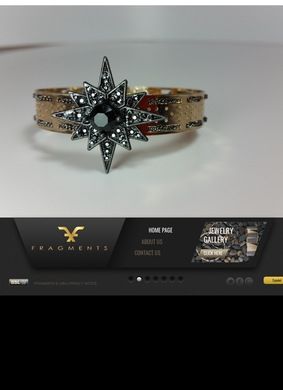
The website that should anchor this listing is down. Visit fragments.com and the server returns a 500 Internal Server Error, which is the first and most stubborn thing anyone trying to look up this jewelry retailer will run into. That alone changes how to read everything else, because the picture has to be reconstructed from outside sources and not from the storefront the company built for itself. It is an uncomfortable starting point for a name with a real history behind it.
Founded in 1994 by Janet Goldman, Fragments operated as a New York City jewelry seller with a clear point of view: it gathered the work of many independent designers under one roof. The operation represented somewhere between 60 and 100 designers at a time, names that included Suzanne Kalan, Jordan Alexander, Moritz Glik, Annie Fensterstock, Gurhan, Stephen Webster, Alex Sepkus, and Caroline Ellen. That is a credible roster. Anyone who follows contemporary fine jewelry will recognize at least a handful of those studios, and carrying that mix is a real curatorial choice, not a generic catalog assembled to fill shelf space.
Thirty-odd years is a long run for an independent jewelry house, and it tells you the model worked for a long stretch. Fragments built its identity around being a place where the discovery happened on your behalf. Goldman's eye, by reputation, leaned toward designers who sat slightly ahead of the mainstream, and the company made its money by being early to studios that later became household names in jewelry circles. The track record with names that subsequently got big is the strongest evidence of genuine taste operating behind the buying decisions.
The multi-designer model and who it served
The structure here is worth dwelling on because it explains who Fragments was for. The business did not produce its own line; it acted as a showroom and retailer for outside makers, spanning both fashion jewelry and the higher end of fine jewelry. It sold two ways at once: to trade buyers sourcing for their own shops, and to retail customers walking in off the street. That dual channel is harder to run than a single storefront, and it positioned the company as a kind of clearinghouse where an established designer and a newer one could sit in the same case without one undercutting the other.
That blend of fashion and fine pieces mattered. A shopper could come in for something playful and relatively affordable, or for a serious investment piece, and find both addressed under the same name. Fragments did not pin itself to one price tier, which widened who it could serve and which designers it could stock. For an emerging maker, getting placed alongside someone like Gurhan or Stephen Webster carried obvious value, and that hosting role is part of why the company mattered to the trade as much as to walk-in buyers.
Physical retail backed Fragments up. There was a SoHo address at 116 Prince Street and an Upper East Side location at 997 Madison Avenue, two of the more competitive jewelry corridors in the city. Holding ground in both downtown and uptown Manhattan says something about the scale the business reached. For a buyer, the appeal of a place like this is concentration: instead of chasing nine separate studios, you could see a representative slice of contemporary work in one visit and compare designers in person, which is a practical argument for the format, separate from the taste question.
I find the curation angle genuinely interesting, and it is the strongest reason the name still carries weight among people who track this corner of the market. A multi-designer destination lives or dies on the taste behind the selection, and the designers listed suggest the taste was real. The problem is that none of this is verifiable through the company's own channels right now, which puts any assessment of current operations on shaky ground.
Reputation and the closed-door problem
What outside platforms show about Fragments is mixed and, frankly, sparse for a business of this vintage. Facebook carries 9 reviews with a 78 percent recommendation rate, a small sample landing on the positive side without being overwhelming. Yelp has an 11-review page for the SoHo shop and a separate page for the Madison Avenue address that shows some review activity of its own. The Better Business Bureau lists the company as Fragments Holding LLC at 42 West 39th Street in New York, but carries no rating. No Trustpilot or Google totals turned up tied specifically to fragments.com, which is notable for a retailer that operated across multiple Manhattan addresses for decades.
The harder signal is the status itself. Yelp marks the SoHo location as closed. Combined with a website throwing a server error, the weight of the evidence points to a business that has either wound down its public-facing operation or gone dormant. It would be wrong to overstate what a 500 error proves on its own. Servers break, hosting lapses, and a site can be revived. But a closed SoHo shop and an unreachable site reading together is not something a careful person should wave away, and it leaves the company in an awkward spot for anyone evaluating it now.
For anyone hoping to actually shop or place a trade order, this matters more than the designer roster does. A curated selection is only useful if you can reach it. The contact numbers that survive in third-party listings exist in outside directories rather than on a live company page, so there is no way to confirm from the source whether anyone is answering them or whether either location still trades. Without a working Fragments site, even basics like current hours or which showroom is still open cannot be confirmed.
For a Manhattan jewelry house that ran for three decades, the surviving review volume is thin. That can happen with businesses whose core relationships were trade-based and conducted offline, where designers and buyers dealt directly and never left a public rating. The quiet review trail fits a wholesale-leaning operation more than it suggests anything went wrong, but it leaves an outside observer with less to lean on than the company's pedigree would lead you to expect.
On its merits as a concept, Fragments was a serious player: a long-running, designer-driven retailer with two prime Manhattan addresses and a roster that holds up to scrutiny. The history is real and the names are real. The pedigree is solid in a way that a lot of newer jewelry brands cannot match, and that counts for something even now, years after the SoHo doors closed.
If you came hoping to buy from Fragments today, the honest reading is far more cautious. The site does not load, the downtown shop is listed as closed, and the only contact paths are secondhand numbers scattered across other platforms. Treat any plan to transact as unverified until the company puts a working site or a confirmed open showroom back in front of customers. Anyone curious about the designers the company once carried would do better to approach those studios directly, since most of them sell or distribute on their own. The legacy is solid; the present availability is the open question.