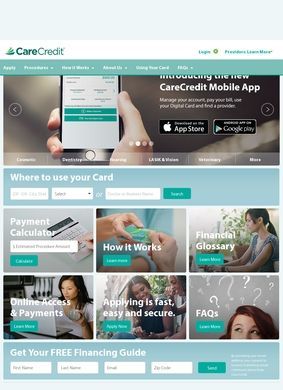
Medical financing in the United States is a crowded shelf. Hospital payment plans, in-house dental membership schemes, general-purpose 0% APR cards, and buy-now-pay-later outfits like Affirm all compete for the patient holding a bill insurance only partly covered. CareCredit is the long-standing incumbent in that field, a credit card aimed squarely at health and wellness costs, issued by Synchrony Financial, one of the larger consumer lenders in the country. The Synchrony connection is the first thing a prospective applicant should hold onto, because it sets expectations correctly: this is a revolving credit product with the interest rates, deadlines, and credit-report consequences any card carries, not a friendly payment plan from a clinic.
The scope is deliberately narrow. CareCredit is not meant for groceries or gas; it is built for out-of-pocket spending on medical and wellness care for a cardholder, their family, and their pets. The listed categories run wider than people expect. Dentistry is the marquee use, but the same card reaches veterinary bills, vision and hearing, chiropractic care, cosmetic and skin treatments, and certain health and personal care purchases at Walmart. The reach claim, more than 285,000 provider locations, is the figure that decides whether the card is worth carrying. A financing card you cannot use anywhere is a paperweight; the value lives entirely in whether your own dentist or your dog's emergency vet already runs it at checkout.
How the financing breaks down
This is where an applicant has to slow down, because CareCredit offers two financing structures that behave very differently and one of them is a trap for the inattentive. The first is short-term promotional financing of the deferred-interest variety: clear the full balance inside the promotional window and you pay no interest. Miss that deadline and interest can be charged back to the original purchase date on the whole amount, well beyond the unpaid remainder. The second path is fixed installment financing over 24, 36, or 48 months at a set rate from day one, with a known monthly payment and a known end date.
The two suit opposite temperaments. Someone certain they can pay a balance off quickly takes the promotional route. Someone facing a large planned expense, an orthodontic course or a major dental restoration, is better served by the predictability of a fixed installment plan. Applications go through online or by phone, and the application sits front and center for prospective cardholders, next to plain explainers on how the card works and which procedures qualify. Confirming that your specific treatment falls inside the eligible categories before applying saves the unpleasant surprise of signing up for financing your provider cannot route through it.
The honest caution here is structural, not incidental. The entire case for CareCredit assumes discipline. Treated as a planning tool with a payoff date circled on the calendar, it converts an unaffordable lump sum into manageable instalments and does so cleanly. Treated loosely, the deferred-interest mechanism does real damage, and the burden of avoiding it falls on the applicant rather than the lender. The terms are there to read, which is more than some financing offers can say, but reading them is non-negotiable, and the product gives no quarter to anyone who skips that step.
The site is organised around three audiences and keeps them genuinely separate. Prospective cardholders get how-it-works and how-to-apply material. Existing cardholders get an account area for payments and balances. The third group is the one consumers tend to forget exists: healthcare providers and businesses. CareCredit equips them with tools to offer the card to their own patients and clients, and the company reports roughly 225,000 health-focused providers plugged into that side. That two-sided model is the mechanical reason the acceptance network is as large as it is. The offices, clinics, and practices presenting the card at checkout are there because CareCredit recruited them, and that recruitment is the product's genuine moat.
None of this makes it a low-stakes choice. It is borrowing, full stop, with the interest and the credit consequences borrowing brings. The narrow focus does count in its favour: a tool pointed at one job, dental work and vet bills and the wellness costs insurance shrugs off, tends to outperform a do-everything card in that lane. Where CareCredit is straightforwardly strong is reach. A patient can reasonably expect their existing provider to already accept it, and for a financing product that is the whole ballgame. Where the buyer should stay alert is the deferred-interest path, which is sold beside the safer installment option and is easy to choose without grasping the difference.
Outside reputation is mixed and should be read with care. Google and Trustpilot each carry thousands of reviews, with ratings that split sharply. That split is typical of financial products, where one bad billing episode pushes a customer to post while the satisfied majority stays quiet. The headline star average is close to meaningless here; the texture of complaints is what tells you anything, and the recurring theme worth scanning for is deferred-interest billing gone wrong, which lines up exactly with the product's known weak point.
The verdict is conditional, and the conditions are not optional. CareCredit earns a qualified recommendation only for an applicant who reads the deferred-interest terms in full, calls the provider to confirm acceptance, and fixes a payoff date before charging anything. Meet all three and the card delivers what it promises. Fall short on any one and this becomes an expensive way to finance a crown, and the safer move is a fixed installment plan or a flat-fee in-house option from the provider directly.