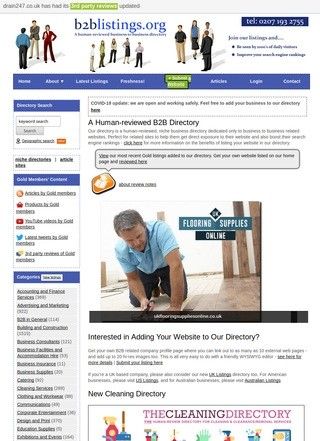
General trade directories have always had a structural problem: cram enough categories in to chase volume, and the vendor selling industrial hydraulic seals ends up sandwiched between a nail salon and a pet groomer. B2B Listings was built around rejecting that model. Every submitted entry goes through human editorial review before it appears, the catalogue holds 48 categories covering building and construction, IT, legal services, manufacturing, web design, and professional services, and B2B Listings has enforced that B2B-only scope since launching in 2009, with the working platform variously cited as operational around 2012. Fourteen-plus years of continuity in a space that has buried dozens of imitators is not a trivial fact.
The spider audit: what separates it
B2B Listings runs a web spider that crawls every listed domain and returns automated audit results alongside sentiment analysis for the site. This is the feature worth understanding first, because it is the only one in this niche that goes beyond passive hosting of a name and a URL. A directory that inspects what it lists and hands something actionable back to the vendor is doing a second job, and most directories in this segment never attempt it.
The audit depth is not spelled out publicly, which means a vendor cannot evaluate the output before signing up. That opacity is a genuine limitation. The audit is also not a replacement for a dedicated SEO platform: Screaming Frog or Ahrefs will go deeper, faster, with more configuration options. But for a trade company that has never run a systematic crawl on its own domain, getting one bundled into a directory listing is a more defensible reason to pay than any claim about daily visitor counts.
The platform reports thousands of daily visitors. Self-reported traffic figures from directory operators are structurally unverifiable: the number cannot be checked from outside, and this one is no different from every other directory making the same assertion. The bulk discount (up to 50 percent when a company submits several entries simultaneously) is at least a testable, specific part of the commercial offer. A Gold listing tier promises enhanced visibility and stronger placement within category results, which is standard directory pricing architecture across the segment.
Profile depth and what the platform allows
Each listing on B2B Listings can carry FAQs, selling points, images, external links, aggregated articles, product feeds, and YouTube videos. The floor for comparable directories is a name, a blurb, and a backlink. B2B Listings sets the permitted ceiling higher: a procurement researcher arriving on a well-populated vendor page has something to evaluate before clicking away. Whether individual listed companies bother to fill all those fields is outside the platform's control, but the architecture encourages depth over stub entries.
The 48-category count is small by general-directory standards. It is the right size here. Expanding to 400 categories would mean diluting the B2B editorial filter to fill the slots, which undoes the premise the platform has held for over a decade. B2B Listings has chosen scope discipline over volume, and that choice accounts for much of why the platform still exists when many directory ventures from the same era do not.
Third-party record and contact
Web of Trust carries no submitted reviews for the domain. TradeFord hosts a descriptive profile entry with no attached rating or review count. Sur.ly flags the domain as unlikely to carry malicious content, a useful data point on safety grounds and entirely silent on service quality. Trustpilot, Yelp, the BBB, Google reviews, and Glassdoor returned nothing for B2B Listings. Only other directory aggregators surfaced the platform's name.
Zero independent reviews from past customers is a harder position than zero bad reviews. Companies selling listing subscriptions to trade firms rarely accumulate consumer-facing feedback, granted. A vendor weighing Gold tier placement or a bulk submission is still working entirely from the site's own presentation, with no outside voice to triangulate against. For a platform whose pitch rests partly on the audit feature, one or two published case studies showing actual audit output would address this gap more directly than anything else B2B Listings could add to the site.
Phone number and physical address do not appear in the site header or footer. A contact page is reachable from the main navigation menu, so there is a route to get in touch. The asymmetry is that a procurement firm evaluating B2B Listings as a platform partner will look for those details on the homepage first, and not finding them there creates a small but immediate friction that is entirely avoidable.
B2B Listings has a genuinely differentiated feature in the crawl-and-audit tool, a coherent editorial scope it has maintained for over a decade, and a profile format built for vendor depth over stub entries. The absence of any independent customer record means a new subscriber is taking the platform entirely at its word on what gets delivered. A standard entry to test the audit output is the reasonable way in; any decision to scale up to Gold placement should follow evidence, not the listing.