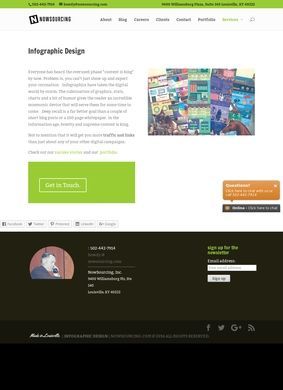
The budget tiers are right there on the page, which is the first thing worth noting: under $3,000, $3,000 to $5,000, $5,000 to $10,000, and $10,000 and up. That kind of upfront pricing is uncommon for a creative agency, where the usual answer is "let's talk." NowSourcing, the Louisville, Kentucky shop behind this Infographic Design listing, puts the numbers in plain sight before anyone has to send an inquiry. It tells you immediately whether you are in the right ballpark, and it sets a serious tone for an agency that clearly does not want to waste time on misaligned leads. The Infographic Design service page is the front door for that pricing, and it does not make a visitor work to find it.
The core of the offering is visual content built to carry data. Static infographics anchor the menu, alongside interactive infographics, motion graphics and video work, presentations, and longer-form pieces such as whitepapers and ebooks. The stated goal goes past decoration: the agency frames its work around driving traffic, earning press pick-ups, and generating backlinks. That marketing-outcome framing matters, because it positions Infographic Design as a service for companies running campaigns, not for someone who simply wants a pretty chart for a slide. The work is meant to travel and get shared. The bigger budgets buy the kind of production (animation, interactivity) that tends to get picked up by editors and bloggers, and the motion and video pieces sit at the upper tiers for exactly that reason. Animated explainers cost more than a flat graphic and do heavier lifting on social platforms, so the tiers track production reality.
Client roster and the credibility it carries
The list of past clients is the part that genuinely changes how you read the rest of the page. Across third-party sources the agency is associated with Twitter, Google, Microsoft, Red Bull, Adobe, FedEx, Forbes, ESPN, GE, American Express, and the Bill and Melinda Gates Foundation. That is not a roster you accumulate by accident. When a shop has produced visual content for organizations of that size and scrutiny, it has cleared procurement, legal review, and brand-guideline approval at companies that do not hand their identity to amateurs. Logo walls are easy to fake in isolation, but this one is broad enough across industries (tech, media, beverages, finance, philanthropy) that it reads as real range, not one lucky contract repeated in several formats. Infographic Design clearly operates at a level where that kind of scrutiny is routine, and the breadth of sectors suggests the agency has adapted its approach to genuinely different client needs over time.
Pair that with the explicit pricing and the picture becomes coherent. An agency that has worked with Forbes and ESPN could plausibly hide behind "enterprise quote on request," yet Infographic Design publishes a floor under $3,000. The range is wide enough to take on a small business with a modest campaign and a major brand with a five-figure motion project. The portfolio and case studies section on the site lets a prospect check the claims against finished work, which is where logo lists should always be verified. For a buyer comparing shops, Infographic Design gives more to inspect before a first call than most competitors offer.
There is also a personal dimension that small agencies often miss. The site offers a booking option for a consultation call directly with the founder, Brian, and the agency takes on speaking and media engagements. Founder access at the sales stage is a reasonable signal for a buyer who wants to gauge fit before committing real money, and it suggests the shop is still owner-led and not buried under layers of account managers. The person who shapes the creative direction at Infographic Design is the same one you can speak to before the contract is signed.
Reputation signals and how to reach them
On outside platforms the strongest marker is Clutch, where Infographic Design carries 66 reviews on an active profile with detailed client feedback. The research did not surface the headline rating, but 66 logged engagements is a substantial volume for a niche specialist. Clutch reviews are typically vetted with named projects and budgets, which makes them harder to manipulate than open star ratings. DesignRush hosts an agency profile with reviews present, CrowdReviews lists the shop and compares it against competitors, and TopSEOs ranks Infographic Design among top providers in the field. No Trustpilot, Google, Yelp, or BBB counts came back in the search, so the verifiable trail leans toward industry-specific review networks and away from general consumer sites. For this kind of B2B creative work, those professional directories are where buyers genuinely look, so the absence of consumer-platform ratings says little about the quality of the work itself.
Getting in touch is straightforward. A phone number and email address sit on the services page, and the consultation booking adds a third route for anyone who would rather schedule a call than send a cold message. Plenty of agencies bury contact behind a single form, so Infographic Design gets credit for making the basic step easy.
The open questions for a careful buyer are the exact Clutch rating, which the research did not return, and the fact that the budget tiers describe price ranges without itemizing what each tier buys in deliverables. Neither is a real strike against the agency; they are prompts for the consultation call. Ask what a project at your specific tier includes in revisions, formats, and distribution support. The tiers tell you the price; the conversation tells you the scope, and Infographic Design makes that conversation easy to start.
The consistency of the signals is what makes this page worth taking seriously. The pricing is public, the client list is verifiable through the portfolio, the review trail exists on the platforms where B2B buyers look, and contact is genuinely easy. Together they describe a shop that has nothing to hide and a track record long enough to back the claims. For an agency selling something as easy to overpromise as "content that goes viral," that transparency does most of the persuading. Infographic Design reads as a substantive operation rather than a landing page chasing leads precisely because the evidence is there to inspect rather than asserted and left hanging.
The one caveat worth holding onto is the same one that applies to any campaign-oriented creative work: traffic, press, and backlinks depend on distribution and timing as much as on the asset itself, and no design shop fully controls whether a piece gets shared. Infographic Design frames its work around those outcomes, but a prospect should treat them as the aim and not a guarantee, and judge a tier by the quality of the deliverable first.
For a marketing lead or content manager planning a data-driven campaign with a real budget, this Infographic Design listing points to a credible place to start. Book the consultation call with Brian, bring a specific campaign and a tier in mind, and ask what that tier covers in formats, revisions, and promotion before signing.