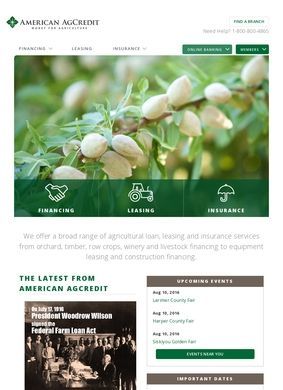
Who lends to a cattle operation in New Mexico or a vineyard in Sonoma County when a regular bank balks at the seasonal cash flow? American AgCredit answers that question directly. It is a Farm Credit System cooperative, which means it exists to finance agriculture and rural property, and the loan menu reflects that focus without distraction: real estate loans, operating loans and lines of credit, equipment financing, agribusiness loans, and rural home loans. The borrower is a farmer, a rancher, or someone holding rural acreage, not a general consumer shopping for a personal loan. That clarity about who this institution serves comes through quickly on the site, and it is genuinely useful.
The cooperative structure shows up in something concrete. Because American AgCredit is member-owned, it pays patronage back to its borrowers, and the site reports returning close to a billion dollars in cash patronage to members since 2005. That is a mechanism that lowers the effective cost of borrowing, and it is the kind of number a prospective member can weigh against a commercial bank's rate sheet. A borrower who pays interest one year and gets a slice of it back the next is in a different financial relationship than a typical bank customer, and the cumulative patronage figure gives you a sense of the scale involved.
Beyond straight lending, the offering widens in ways that fit the same audience. American AgCredit sells crop insurance and life insurance, runs treasury management services, and lists capital markets services that it says reach all fifty states. The direct-lending territory is narrower: California, Colorado, Hawaii, Kansas, New Mexico, Nevada, and Oklahoma. That split is worth noticing before anyone gets too far into an application. A grower in Iowa can use the broader capital markets arm but will not get a real estate loan booked directly through this institution, and the site is honest enough to draw that line clearly rather than burying it.
Research tools and online access
Under an Ag Insights section, the site carries a research feature called Terrain, paired with industry news and customer stories. This is the part that separates American AgCredit from a lender that simply takes applications and disappears between renewals. Agricultural borrowing decisions hinge on commodity outlooks, input costs, and regional conditions, so a lender that publishes its own research is handing members something they would otherwise pay an analyst for. Whether the analysis runs deep or stays at summary level is something a serious prospect should read for themselves, but the presence of it points to an institution trying to be useful across the loan cycle, well past the moment of closing.
For account holders, there is an online banking portal with enrollment options, which is table stakes for any modern lender but still worth confirming exists. A member managing a line of credit through a planting season needs to see balances and move money without a phone call every time. The portal covers that day-to-day need. American AgCredit also runs social channels on Facebook, Instagram, Twitter/X, and YouTube, where some lenders post educational content that supplements the formal research tools. Whether any of it is decision-grade or just brand material is harder to judge from the outside.
One more credential is worth noting in this category. American AgCredit holds a BBB+ credit rating from S&P with a stable outlook. For a lender, its own creditworthiness is a meaningful indicator, not a vanity metric. It speaks to the institution's ability to fund loans through good years and bad, and for a borrower planning a multi-year capital project, the financial stability of the lender is genuinely part of the deal.
On the customer-experience side, the evidence is mixed, and it is fair to say so plainly. The reputation footprint outside the company's own pages leans heavily toward employees rather than borrowers. Glassdoor shows 78 employee reviews averaging 3.4 out of 5, with 58 percent saying they would recommend working there. Comparably reports a B+ overall culture grade drawn from a small panel of about a dozen employees. Indeed carries reviews too, though the count is not stated clearly. Those numbers describe what it is like to work at American AgCredit, which is useful context but not the same as knowing how it treats a borrower in a workout situation or when a harvest falls short.
The borrower-facing reviews are few and unflattering: Yelp lists just two customer reviews averaging one star. Two reviews are far too few to draw a conclusion from, and a single dissatisfied borrower can drag a tiny sample to the floor. The honest read is that there is no large pool of independent customer feedback on Google, BBB, or anywhere else to confirm or contradict the service quality. A prospective member should treat the lending terms and the patronage math as the solid ground, and the public service record as genuinely uncharted. Talking to existing members in the same region would tell you more than any star count here.
Reaching American AgCredit is straightforward. A phone line, (800) 800-4865, sits prominently on the site, and a branch and location finder lets a borrower find the nearest office. In agricultural lending, a relationship manager who understands local crops and land values is part of the value. For a lender whose direct territory spans seven states, the branch network plus a single national phone number is a sensible setup, and none of it requires digging through forms to find.
Pulling it together: American AgCredit is a focused, financially sound agricultural lender with a real cooperative payback model, a working insurance and treasury arm, and research tools that give members something beyond a loan portal. The caveats are the narrow direct-lending map and the absence of meaningful independent borrower reviews. Set against Compeer Financial, another large Farm Credit cooperative serving the Upper Midwest, the choice often comes down to geography first. A grower inside the seven-state footprint has solid reason to take American AgCredit seriously; one outside it may find Compeer or a regional Farm Credit association a closer fit, and proximity to a lender who knows your ground tends to count for as much as the rate.