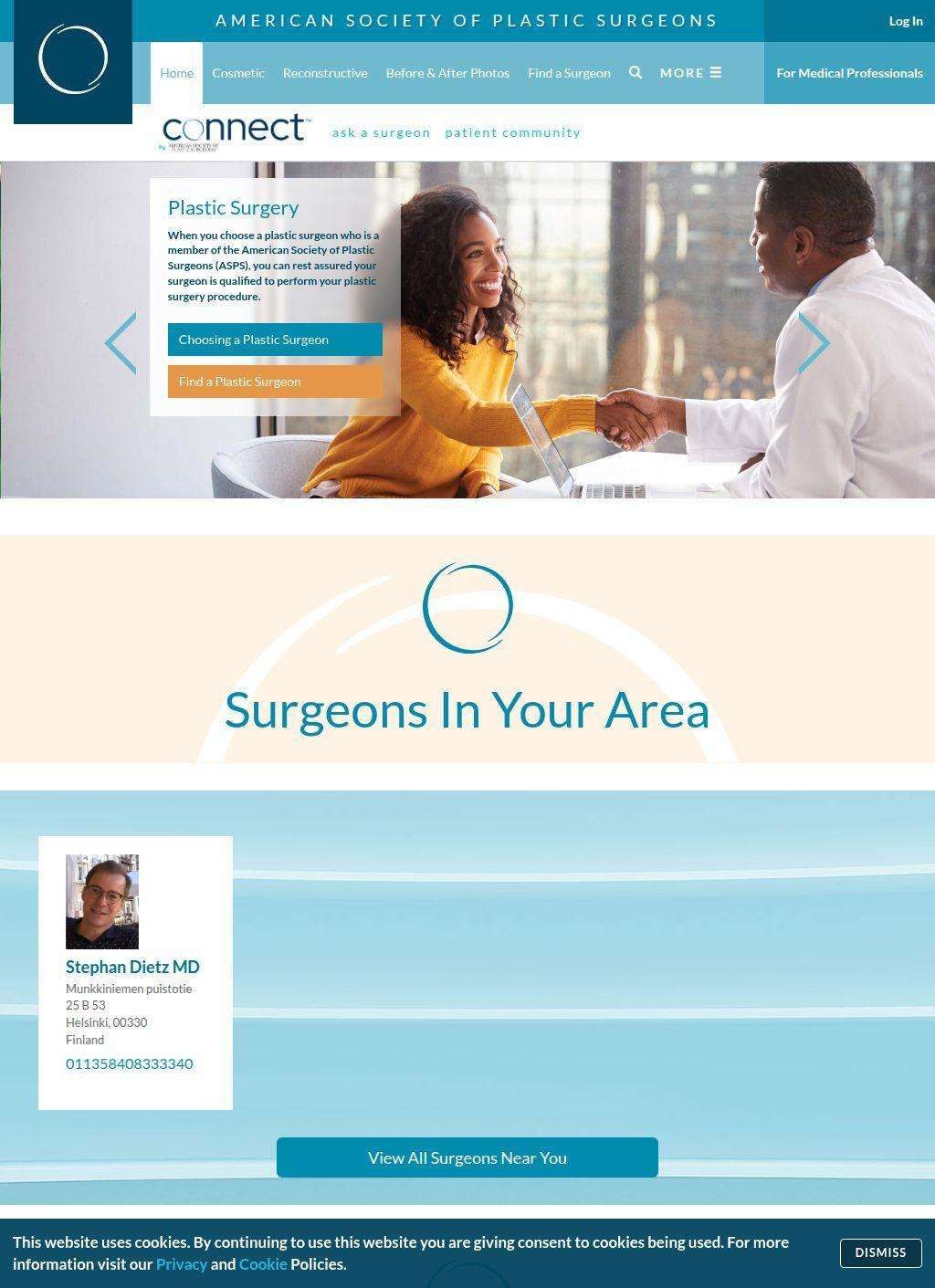
Patients researching cosmetic or reconstructive procedures before their first consultation often end up at the American Society of Plastic Surgeons, and the site gives them more than a basic orientation. The procedure library covers breast augmentation, facelift, liposuction, rhinoplasty, breast reconstruction, cleft repair, hand surgery, and scar revision, with patient safety material running beside each procedure description rather than tucked into a separate section. That structure makes a difference for a nervous first-time reader who might otherwise skip past the safety content.
Laser skin rejuvenation, which is what brings this particular listing into view, lives inside the broader cosmetic procedures section. That placement says something about how the American Society of Plastic Surgeons frames non-surgical skin work. Laser resurfacing appears as one option on a spectrum that runs across both surgical and non-surgical choices, not as a standalone category on its own page. A reader arriving specifically for skin-treatment information gets the same structured explanation, the same safety framing, and the same access to the surgeon finder that someone researching a major operation would get.
Finding a surgeon and reading before you go
The board-certified surgeon finder is the tool most people reach for first, and it is the feature that gives the educational content its practical weight. Rather than pointing visitors toward a vague suggestion to ask their doctor, the American Society of Plastic Surgeons lets them search for surgeons who hold the relevant credential. That single function changes how the procedure guides read, because the information is not abstract. You learn what a procedure involves and can then look for someone qualified to perform it.
Supporting that are before-and-after photo galleries, 3D surgical animations, and video content. The animations communicate things that paragraphs cannot, particularly for a nervous first-time researcher trying to picture what happens during a procedure. I found the pairing of plain-language writing with visual aids to be the element that held a hesitant visitor the longest. There is also an "Ask a Surgeon" forum where member surgeons field patient questions, plus a patient community platform where people compare notes with each other.
That combination keeps the two kinds of input from blurring together. A patient can read what a credentialed surgeon says about laser resurfacing recovery, then step over to the community side to see how it actually went for people who had it done. The American Society of Plastic Surgeons keeps those channels distinct, which is the right call when one carries clinical authority and the other carries lived experience.
The professional side of the site is substantial enough that it deserves its own description. Membership resources, continuing medical education, and advocacy tools sit here, but the clinical registries are the standout. GRAFT, NBIR, and PROFILE are data-collection efforts that feed back into how the specialty understands outcomes, and hosting them publicly signals that the American Society of Plastic Surgeons treats evidence as part of its organizing remit. This is not consumer-facing content, yet its presence tells a patient something useful about the organization behind the procedure guides.
Publishing reinforces that impression. The site carries Plastic and Reconstructive Surgery, the peer-reviewed journal known as PRS, along with PRS GO, its open-access companion. Dedicated forums for early-career surgeons and for women in the specialty add to the professional infrastructure, and those details are worth noting because they reflect who the American Society of Plastic Surgeons is trying to support inside the profession. None of this is dressed up for the casual visitor, and it does not need to be. A patient skimming the procedure pages may never click into the journals, but knowing they exist puts the educational material in context.
Beyond the procedure and member material, there is a steady stream of current information. The American Society of Plastic Surgeons publishes annual procedural statistics, with the 2024 Procedural Statistics Report as the most recent edition, and that data is the kind journalists and researchers cite when they want to know what is trending in the field. A surgery blog and a vlog add a more conversational layer, and a general news section keeps the front of the site from going stale. The statistics in particular are a genuine resource because hard numbers on procedure volume are difficult to find elsewhere with the same credibility.
Corporate partnership and foundation information are also hosted on the site, which rounds out the picture of an organization operating on several fronts at once: educating patients, supporting surgeons, gathering outcomes data, and funding work through its foundation. The navigation does a reasonable job of keeping those audiences from tripping over each other. A patient researching skin treatments is unlikely to wander into the advocacy pages by accident, and a surgeon looking for CME credits will not be slowed down by the patient community forums.
What gives the American Society of Plastic Surgeons its particular value for the laser skin rejuvenation visitor is that the non-surgical content is not isolated. Someone weighing laser resurfacing can read about the procedure, understand where it fits among other options, check the safety guidance, and then search for a credentialed practitioner, all in one continuous path. The American Society of Plastic Surgeons does not push laser work as a quick fix; it places it within the same careful framework that governs the surgical entries.
If there is a limitation, it is one of breadth becoming density. The American Society of Plastic Surgeons covers so much ground that a first-time visitor can feel the size of the place before finding their footing. A patient who arrives only for laser skin rejuvenation has to navigate past membership material, journals, registries, and advocacy content that has nothing to do with them. The information is well organized, but the sheer scope means the patient-only path is not always the most obvious one on the page.
Still, the depth is the point. The procedure library covers reconstructive work like cleft repair and hand surgery with the same seriousness it gives to elective cosmetic procedures, which reflects the fact that the American Society of Plastic Surgeons is the specialty's organizing body, not a marketing portal for one slice of it. The 3D animations and before-and-after galleries serve the cosmetic researcher; the registries and journals serve the practitioner; the statistics serve everyone. A visitor who came for one thing tends to find three more worth reading.
For the laser skin rejuvenation researcher landing here from this entry, the route is clear enough once you know to look for it. The American Society of Plastic Surgeons puts the cosmetic procedures section where the skin-treatment explanations live, the safety guides sit beside them, and the surgeon finder turns reading into a next step. The American Society of Plastic Surgeons does not separate its non-surgical content from its surgical content, and anyone weighing laser resurfacing benefits from sitting inside that fuller context. The 2024 statistics report and the surgeon finder are the two destinations most worth bookmarking.
Business address
American Society of Plastic Surgeons
444 East Algonquin Road,
Arlington Heights,
IL
60005-4664
United States
Contact details
Phone: (847) 228-9900