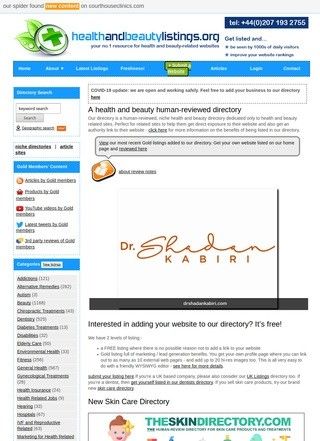
Health and Beauty Listings is a paid-inclusion niche directory for clinics, salons and wellness practitioners, operating from the same domain since November 2009. That founding date is one of the few claims about it that outside sources can confirm, and it does more work for the SEO case than any item on the feature list.
What the Gold tier offers
The free tier gets a business indexed with basic details: crawlable, linkable, unremarkable. The paid Gold tier is a different product. A Gold profile carries up to ten external links, up to twenty high-resolution images, a custom profile page and platform-wide marketing exposure. Ten outbound links on a single paid listing is genuinely unusual; niche directories routinely cap at one or two, which limits the SEO surface area a single listing can carry. Twenty images is also above category average, enough to accommodate a treatment room, product line, staff headshots and before-and-after documentation without forcing any omissions.
Health and Beauty Listings organises more than sixty specialties across its vertical: dentistry, fitness, mental health, nutrition, beauty and sub-categories branching below each. A hypnotherapist and a dermal filler clinic land in different sections of the taxonomy, which is a more considered architecture than a flat alphabetical list. Whether the category tree generates differentiated search traffic for those sub-sections is a separate question, and the listing does not answer it.
The site-audit tool
Health and Beauty Listings includes an AI-powered spider that crawls a listed business's own website and generates improvement recommendations. Directory incumbents in this sector rarely offer anything similar. The output should be treated as a starting checklist for a developer rather than a finished technical verdict, but its presence changes what Health and Beauty Listings is selling: a citation paired with a diagnostic instrument, not a citation alone. Whether that instrument is accurate enough to be useful is something a practitioner would need to test against their own site.
Content and promotion layers
Beyond the audit tool, the platform includes an article repository where businesses and users can publish health and beauty content, product galleries, YouTube video integration, a miniblog and a trending-content section on the homepage. The article and product features extend a paying member's indexable footprint. The miniblog and video integration are supplementary; they add texture without materially changing the case for or against a Gold subscription. An active Twitter account posting as youcanbhealthy promotes featured and Gold entries off-site. For a small practice with no social reach of its own, any external name mention and backlink has some incremental value, however modest the channel audience.
Domain age: the one durable asset
Fifteen-plus years at the same address constitutes a genuine SEO asset. A link from a domain established in 2009 carries a lower risk profile than one from a site registered last year that could disappear or redirect within months. For businesses whose primary motivation is building a durable backlink profile, that continuity is the strongest argument available in the Health and Beauty Listings pitch. Everything else, the feature counts, the content tools, the social promotion, is secondary to that single data point.
Contact and operator identity
The site provides a contact form. No phone number and no physical address appear publicly. For a product that involves a paid subscription, the absence creates an identification problem: a buyer making a Gold-tier purchase needs to know who they are paying. A contact form handles support requests; it does not substitute for the kind of identity information that a registered address or published business telephone would provide. The form appears functional; the operator's identity remains opaque.
Third-party reputation: what the record shows
No notable entries for Health and Beauty Listings appear on Google reviews, Yelp, the BBB or comparable review platforms. A Trustpilot profile surfacing under a similar name belongs to a different domain entirely. The result: no public pool of buyer feedback exists. Every claim about Gold-tier performance, member traffic, ROI and platform reach rests entirely on the site's own copy. For a free citation that costs nothing to add, the absence of outside testimony is inconvenient. For a paid subscription, it is a more serious problem, because the decision to spend money rests on self-reported numbers that no independent buyer has publicly corroborated.
Health and Beauty Listings competes in a sector where Wahanda, RealSelf and a range of other paid-inclusion indexes have accumulated years of confirmed buyer reviews, some with tens of thousands of listed businesses and documented consumer traffic. The niche-and-curated argument that Health and Beauty Listings makes against those competitors is coherent in principle. Nothing in the public record demonstrates it holds in practice, and the directory's own site does not provide any traffic or performance data that would let a prospective buyer evaluate the claim.
The case for Health and Beauty Listings as a free citation is straightforward: the domain age checks out, the niche focus is appropriate, and adding a free link costs nothing. The case for paying for Gold is less settled. The feature specifications are competitive on paper, the link allowance is unusually generous and the site-audit tool is a distinguishing addition. Against that: no outside buyer has publicly described their results, the operator's identity is not disclosed, and the platform has no traffic data in public view. Add the free listing, watch for any referral activity in Google Search Console over sixty to ninety days, and treat that data as the actual basis for the Gold-tier decision.