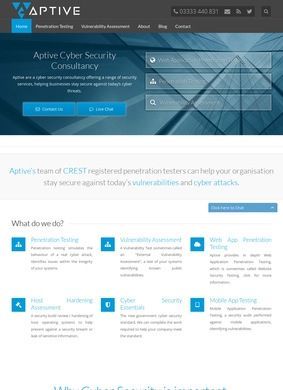
What does a small UK consultancy actually do when it says it tests security by hand? Aptive answers that fairly directly. It runs manual penetration testing for businesses, with people probing applications and networks the way an attacker would, then writing up what they found. The headline services are application penetration testing for web and mobile apps, network penetration testing covering both internal and external infrastructure, vulnerability assessment mixing automated scanning with manual checking, and security build reviews of applications, devices and operating systems. That is a tighter list than many firms in this space advertise, and the narrowness reads as deliberate. Aptive is not trying to be a managed-security suite or a broad platform covering every infosec discipline; the offering is scoped to what the team demonstrably does.
The credentials behind that list are the part worth pausing on. Aptive is CREST-registered and says its testers hold the OSCP certification. For anyone who has bought security testing before, those two markers mean something concrete. CREST membership means the firm has been assessed against an industry standard, and OSCP is a hands-on offensive-security qualification rather than a multiple-choice paper exercise. A buyer who has been burned by a "pen test" that turned out to be a Nessus scan with a logo on it will recognise why those badges matter here. They do not guarantee a good engagement, but they raise the floor in a market where entry barriers can be embarrassingly low. Aptive's registration details are also verifiable: the company is registered in England and Wales under company number 07867021, based in London. Knowing exactly which legal entity you are contracting with is not a trivial nicety when you are handing a stranger permission to attack your systems.
The knowledge base
Beyond the service pages, the site carries a security knowledge base of more than a hundred blog articles. This is where Aptive does more than describe itself. The articles run through SQL injection, cross-site scripting, the OWASP standards, privilege escalation, port scanning, rate limiting, gaps in multi-factor authentication, and general penetration-testing methodology. The intended readers are a mix: security professionals who want a reference, developers trying to understand a vulnerability class before they ship, and business owners who need the plain-English version.
A library that size is difficult to keep current, and the volume invites the expectation of filler, but the topic spread points to practitioners writing about work they do rather than an SEO team padding a content calendar. Whether every piece is up to date is something a reader would have to judge article by article. That said, the content does quiet work on trust. A firm that explains, in public and in detail, how an attack like privilege escalation unfolds is implicitly showing its own technical literacy. It is one thing to claim OSCP-certified testers on a services page; it is another to publish a hundred-plus articles that would expose shallow understanding almost immediately. The knowledge base, taken together with the certifications, gives a coherent picture of a team that knows the material.
Reputation and outside validation
Where the picture gets murkier is outside validation. Searching for what other people say about Aptive turns up very little in the way of public, scored feedback. There is a listing on approvedbusiness.co.uk describing the penetration testing services, but it carries no numerical rating and no review count. Aptive runs an active presence on X under @AptiveSec. What is absent is independent corroboration buyers often lean on: no Trustpilot profile, no cluster of Google reviews, nothing on Glassdoor or the other major platforms. For a firm registered since the early part of the last decade, that gap is worth noting.
It is worth being fair about why that might be. Security testing is confidential by nature. Clients rarely want to broadcast that they hired anyone to break into their systems, let alone leave a public star rating describing the experience. Reputation in this corner of the industry tends to travel through professional networks, referrals and the CREST register itself, none of which shows up as a tidy number on a review site. So the empty review profile is not damning the way it would be for a restaurant or a plumber. The certifications arguably do more reassurance work than a handful of anonymous testimonials ever could.
Still, that explanation only carries so far. Plenty of confidential B2B services do accumulate some public footprint over the years, through case studies, named client logos, conference talks or willing referees who go on record. From what the research surfaced, Aptive leans almost entirely on its own site and its certifications to make the case. A prospective client who wants a second opinion has very little to work with publicly and would likely need to ask Aptive directly for references, since none surface in the open record.
On reaching the company, there is little to complain about. A phone number and an email address are both present on the site, and the contact route is easy to find. For a consultancy that will need to scope work, sign agreements and coordinate testing windows, having a direct line visible matters. Aptive makes that obvious, which is right for a service that begins with a conversation about what you want attacked and when.
Overall assessment
The focused service list and the depth of the knowledge base both point to specialists who do this for a living. A business that already understands it needs hands-on penetration testing, values CREST and OSCP as buying criteria, and is comfortable doing its own due diligence through references and a scoping call will find Aptive a credible option. Someone hunting for a managed-security suite or a one-click automated scan is in the wrong place, and that is not a criticism so much as a matter of fit. Aptive does not try to be everything; it narrows to a specific kind of work and publishes enough technical writing to suggest it does that work seriously.
The honest sticking point is the one the site itself cannot resolve. Aptive presents a consistent, technically literate front: the right registrations, the right certifications, a serious body of writing and an easy way to make contact. All of that is verifiable. The gap is the absence of any independent verdict on what the actual engagements are like, whether reports are clear and actionable, whether deadlines hold, whether the testers found what mattered. The credentials tell you Aptive is qualified to do the work well. They cannot tell you that it consistently does, and on that question the public record stays silent.
Business address
Aptive Consulting Ltd
The Surrey Technology Centre, 40 Occam Road, Surrey Research Park,
Guildford,
Surrey
GU2 7YG
United Kingdom
Contact details
Phone: +44 (0)3333 440 831