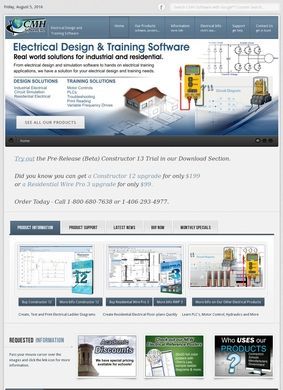
CMH Software is a small Montana developer that has been building electrical design and training software out of Libby since 1994, which puts it past the three-decade mark in a niche most people never think about until they need it. The two programs at the center of the catalog are Constructor 16 and Residential Wire Pro 5. Constructor 16 lets you create, test, and print electrical ladder diagrams; Residential Wire Pro 5 is aimed at laying out residential electrical floor plans. Both have a clear audience: working electricians, electrical engineers, students learning the trade, and the schools that teach them.
What stands out is the academic angle built into Constructor 16. There is a remote learning option and academic pricing, which tells you CMH Software did not build this only for the shop floor. An instructor running a class on diagram logic gets a tool that students can use at home, and the combination of testing plus printing means a teacher can set an exercise, have learners build the ladder logic, and check the result without standing over every screen. That is a practical fit for a classroom, and it is the sort of feature a company arrives at only after years of selling to the people who teach.
Constructor 16 and the diagram side
Ladder diagrams are the language of relay and control logic, and software that creates, tests, and prints them sits in a fairly specialized corner. Constructor 16 covers all three steps, and a diagram you cannot validate is just a drawing. The testing piece is what separates a real design tool from a sketch program, and CMH Software has had a long runway to refine it. Version numbers in the teens usually mean the bugs that bite first-time users were sanded off many releases ago.
Residential Wire Pro 5 handles a different job, taking the user from logic into physical layout. Designing residential electrical floor plans is its own discipline, with circuits, fixtures, and code considerations that do not map neatly onto an industrial diagram. Keeping the two as separate products is the honest choice. A bloated all-in-one would serve neither the contractor wiring a house nor the engineer modeling a control panel as well as a focused tool does, and CMH Software appears to understand that clearly.
Constructor also shows up on CNET Download in a Windows build, where it carries a user rating, though the review count did not surface in any search. A third-party download host is a small sign of reach beyond the company's own storefront, and for niche professional software, that kind of presence is not nothing.
Posters, reference cards, and the teaching material
Beyond the two applications, CMH Software sells educational reference materials: electrical posters and reference cards, plus training content on topics such as Ohm's Law, basic electrical symbols, contacts, and the various types of electrical diagrams. This is where the company's character comes through most clearly. A pure software shop rarely bothers printing posters. A teaching-minded one does, because a poster on a shop wall or a card in a student's pocket is how this material gets absorbed in the day-to-day.
That spread of products, from interactive software down to a laminated reference card, shows CMH Software understands its customers learn in different ways and at different stages. The student starting with Ohm's Law and symbols is on a path that can lead to Constructor 16; the reference card is the cheap entry point, the software the deeper investment. The line reads as something built by people who know the trade rather than a grab bag of unrelated items added over time.
If there is a limit, it is the inherent narrowness. CMH Software covers electrical design and electrical education, full stop. Someone outside that world has no reason to be here, and the company does not pretend otherwise. For the audience it targets, that focus works in its favor.
On outside reputation, CMH Software has a product profile on G2, the software review platform, though no review tally or star rating appeared in the snippet. A BBB profile exists for the company in Libby, not accredited, and no rating or complaint count surfaced there either. The Facebook page shows a single review without a score. The outside footprint is quiet, which is unsurprising for a long-running specialist serving a defined professional and academic base. High-volume consumer ratings are not how trade software gets judged, and the absence of a large review trail reflects the audience, not the product quality.
Reaching CMH Software is straightforward. The site lists a toll-free sales line, a direct number, and a separate technical support line with stated hours, Monday through Friday, mid-morning to mid-afternoon Mountain time. A sales email is listed as well. The split between a sales number and a dedicated support line is the kind of structure you want from a software vendor, because a question about purchasing and a question about a broken install are very different calls. That a small Montana outfit staffs a support line at all is worth noting for anyone who has been burned by vendors who go silent after payment.
Stack CMH Software against something like AutoCAD Electrical and the contrast is instructive. The big-name CAD suite does far more and costs accordingly, with a subscription model and a learning curve to match. For an electrician or an instructor who needs ladder diagrams and residential layouts done well, without paying for a full industrial design platform, the focused tools from CMH Software are the more sensible pick. Three decades of version increments, academic pricing, and a catalog of teaching materials make CMH Software a credible choice for the trade-and-classroom audience it has spent that time building for, and that targeted fit is exactly what would send me to it over a heavyweight alternative.