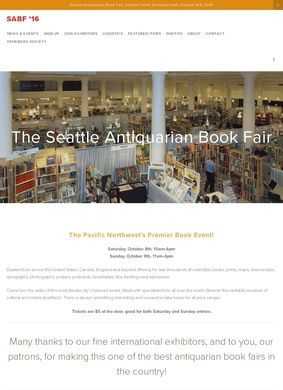
Specialist trade events are easier to promise than to run well, and the Seattle Antiquarian Book Fair has built its reputation the straightforward way: it has been happening long enough that dealers plan around it. The fair runs annually at the Seattle Center Exhibition Hall, and the 2026 edition is scheduled for October 24 and 25, with Saturday hours running into early evening and a shorter Sunday session. Admission is ten dollars, payable in cash, by check, or by QR code. For a gathering of this kind, that price is low enough that it stops being an obstacle and becomes almost incidental.
The website for the Seattle Antiquarian Book Fair is built to answer the obvious questions fast. What is here? When does it run? Where exactly? The answers are on the page before you scroll far. Exhibitors come from the Pacific Northwest and from further afield internationally, and the range of material they bring is genuinely broad: collectible books, prints, maps, autographs, photographs, posters, postcards, ephemera, manuscripts, broadsides, and fine bindings. That list reads as inventory, the right register for an audience that already knows the territory. A first-time visitor gets an honest orientation; a regular buyer gets confirmation that the specialists they follow are likely to show.
The site structures itself around the fair rather than around selling anything, and that shapes how it reads. Sections cover exhibitor registration, venue logistics, an event photo gallery, and a record of featured items from previous editions. The history content gives the Seattle Antiquarian Book Fair some institutional continuity, and the educational presentations from the 2025 fair are the most interesting addition, because they extend the value of the weekend past the two days themselves. Someone who did not attend can still watch those talks; someone considering attending for the first time gets a real sense of what depth means in this hobby before they buy a ticket.
The Seattle Antiquarian Book Fair calls itself the Pacific Northwest's largest rare book event. The site does not document that claim with attendance figures or dealer counts, so a reader has to accept it partly on trust. What makes it plausible is the described mix: local Pacific Northwest booksellers alongside international specialists, the kind of spread that takes years to build. At that scale, the Seattle Antiquarian Book Fair is the sort of event where better material surfaces, pieces that rarely reach a general shop floor. Whether it is the biggest event of its kind in the region or simply among the biggest, the website does not settle. That small ambiguity does not do much damage either way.
Outside the official page
The reputation picture beyond the organizers' own words is encouraging in character, if limited in volume. A listing on 10times.com carries a 4.0 out of 5 based on a single rating, which is too few data points to rely on. The more meaningful outside reference is a Reddit thread in r/BookCollecting that drew 603 upvotes and 44 comments, with the discussion running positive. For a niche trade event, that level of enthusiast engagement outweighs a lone star rating from an events aggregator. A Wanderlog entry adds descriptive visitor commentary without a numeric score, consistent with people who attended and wanted to say something and did not bother with a formal score.
The most substantive outside coverage of the Seattle Antiquarian Book Fair comes from RareBookHub.com, which has published multiple editorial pieces on individual editions of the fair, including dealer quotes. The tone there is mixed but favorable overall, and mixed coverage from a trade publication is more credible than uniformly positive writeups would be. The fair also appears on the Seattle Center official event calendar, which confirms the venue relationship independently of anything the organizers claim. What is absent is a mainstream consumer footprint: no Yelp page, no Google Business profile, no Trustpilot or BBB listing appeared in a search. For a specialist trade fair, that gap is less damaging than it would be for a retail business. The audience for the Seattle Antiquarian Book Fair lives on forums and trade publications, not on consumer review platforms, so the absence is more about the event's character than about its standing.
Contact details on the Seattle Antiquarian Book Fair site reflect the same dealer-run character. Registration questions go to a named individual, Bill Wolfe, at an email connected to Collins Books. That is a traceable person and a real business behind the operation, which is more reassuring than an anonymous contact form. A general public phone number and a mailing address are not listed, and for most attendees that is a non-issue: the venue is well known, the dates are published, and the entry price answers the practical questions. Anyone with an inquiry outside dealer registration is routed through a single email address aimed primarily at exhibitors, which is the one genuine gap in the site's otherwise thorough logistics information.
The Seattle Antiquarian Book Fair is specific about practical details in a way that many event sites are not. Knowing the exact venue, the precise October dates, the staggered weekend hours, and the dollar admission removes most of the friction that keeps casual collectors away from events of this kind. A photographer who collects postcards can plan a day around it; a manuscript buyer can decide whether it is worth traveling for. The Seattle Antiquarian Book Fair treats its visitors as people who want facts and delivers them plainly, without dressing the event up past what it is. For this particular audience, that restraint reads as confidence rather than modesty.
Where the Seattle Antiquarian Book Fair leaves something unresolved is in how it speaks to people who are not already inside the world. The site is well suited to experienced collectors and dealers who know what broadsides and fine bindings are and why they would make a trip for them. The educational talks from 2025 are a partial answer, but they are one layer of content among many, and a genuinely curious outsider still has to work a bit to understand why a room of specialist dealers is worth ten dollars and a Saturday. The Seattle Antiquarian Book Fair has clear standing within the antiquarian book trade: the RareBookHub coverage, the Reddit thread, and the longevity of the event itself all point the same direction. For the established collector, that record is enough. For someone with no existing connection to the trade, the case rests almost entirely on insider reputation, and the Seattle Antiquarian Book Fair's own website does not do much to translate that reputation into language that lands with a newcomer. That is a narrow criticism of an event that is otherwise well documented and honestly presented.