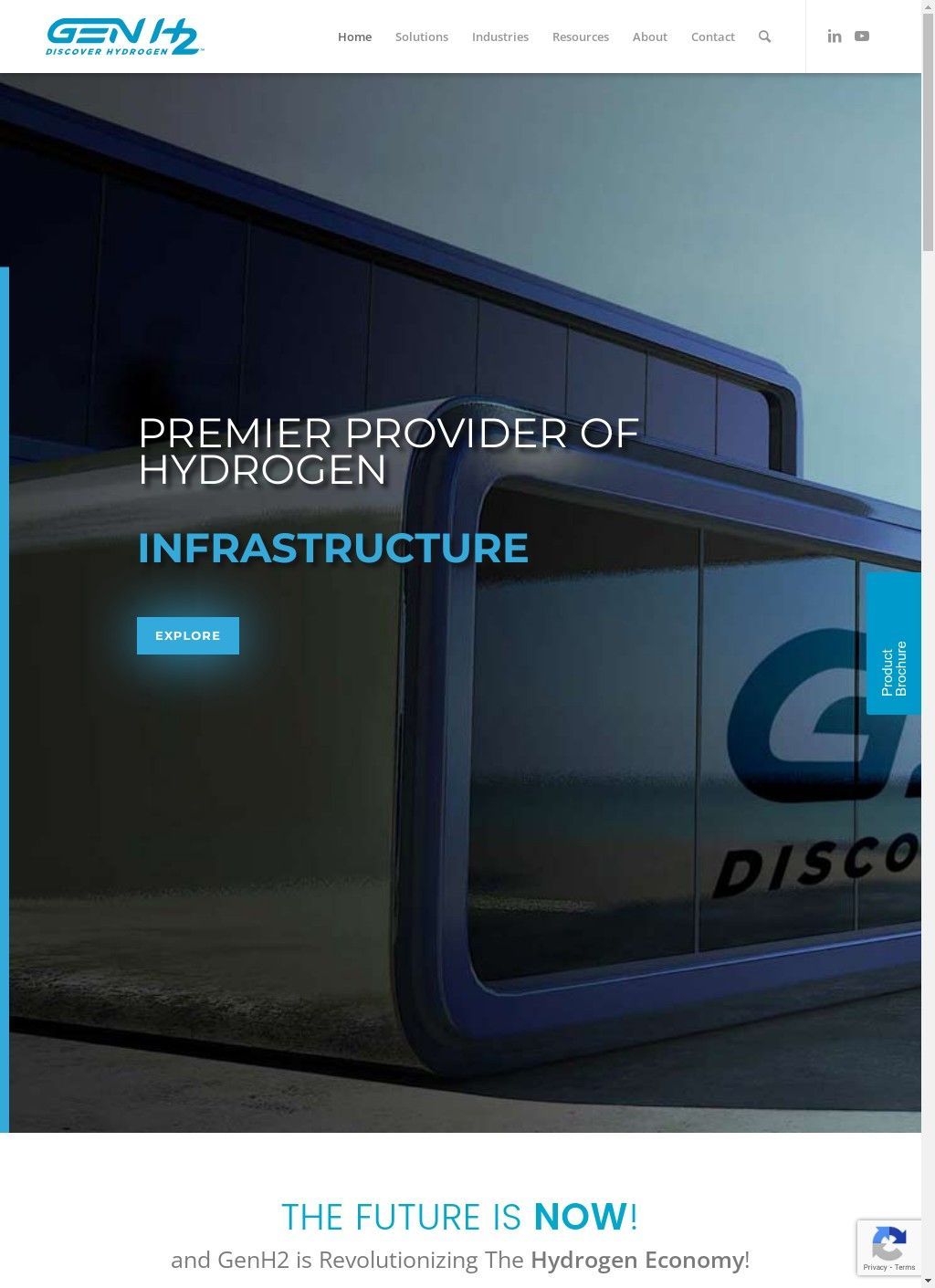
Can you eliminate boil-off from liquid hydrogen storage entirely, or is that claim where the spec sheet and reality part ways? GenH2 Discover Hydrogen says yes, and the RS1500 and RS400 are the hardware it points to. Boil-off is the slow, unavoidable evaporation that makes cryogenic storage expensive even when nothing goes wrong. A system engineered to contain it entirely is aimed at a cost problem every hydrogen fleet operator and industrial buyer already carries before they read page one of any proposal. GenH2 Discover Hydrogen operates out of Titusville, Florida, with a secondary site at Exploration Park on Merritt Island.
What the product catalogue covers
Three lines anchor the GenH2 Discover Hydrogen offering. The RS1500 and RS400 handle zero-loss, boil-off-free liquid hydrogen storage. The LS1000 handles liquefaction, converting gaseous hydrogen to liquid without requiring liquid nitrogen as a pre-cooling stage. Conventional liquefaction chains depend on sourcing and managing a second cryogen on-site, so removing that dependency simplifies the infrastructure a buyer has to build, staff, and maintain over time. The third line is testing equipment, headlined by the Macroflash instrument for measuring heat conductivity. That product puts GenH2 Discover Hydrogen inside laboratory and materials-research budgets as well as fleet infrastructure ones.
The argument running beneath all three product lines is about distribution. GenH2 Discover Hydrogen builds its commercial case around on-site or near-site production and storage, reducing or removing the need to truck liquid hydrogen across long distances. Cold-chain trucking for cryogens is expensive and adds emissions at every transfer point. The equipment catalogue is the implementation of that thesis, not a loosely assembled collection of clean-energy adjacencies.
Six target markets are named across the site, and the selection is more candid than you typically see in vendor literature. Mass transit covers fuel cell buses, heavy trucking covers long-haul fleets, and materials handling covers warehouse forklifts. Forklifts are one of the few hydrogen applications already generating commercial returns at scale today. Stationary power for data centers and industrial facilities is the second mature market in the list. Maritime shipping and aviation appear as well, and those are longer-horizon bets where hydrogen adoption is still developmental and largely unproven at commercial scale. Naming forklifts and container ships in the same catalogue acknowledges where the technology is ready versus where it is aspirational. Any buyer tying capital expenditure to the longer-horizon markets should factor that gap in readiness into their purchasing timeline, because the risk profiles are not comparable.
Credentials and company footprint
The background GenH2 Discover Hydrogen leans on is a lineage of NASA cryogenic work stretching back more than forty years, accumulated near Kennedy Space Center. Proximity to rocket-fueling operations means exposure to failure modes that do not appear in controlled laboratory conditions. That is a more credible origin story than a generic clean-energy pitch, though it is a credential about institutional heritage, not about current production throughput or the number of field installations running today.
The site includes a downloadable literature library, a news and press section, a blog, and a leadership page with named executives. For a capital-intensive infrastructure vendor, white papers and spec sheets are where an evaluation starts, and the literature library is the most useful entry point for a serious technical buyer. Named leadership is standard diligence practice in this equipment category. Anyone purchasing six-figure hardware wants to know who runs the company, beyond whoever answered the phone.
Contact details are published clearly. GenH2 Discover Hydrogen lists a headquarters address, a main phone number, a fax number, and a contact form. An email address for a named staff member also appears in an industry buyer's guide. One navigation note for anyone cross-referencing sources: GenH2 Discover Hydrogen now operates under genh2.com. The older domain, genh2hydrogen.com, was the legacy address, and a number of third-party listings still carry it. The brand and the products are the same under both; they are not two separate companies.
Outside validation
Star ratings on Google, Trustpilot, and Yelp are absent for GenH2 Discover Hydrogen, which is predictable for a B2B hardware company whose buyers are transit authorities and industrial operators rather than retail consumers. Industrial procurement does not run through Yelp, so the absence of star ratings is not a meaningful data point in either direction. What does exist is a standard corporate digital footprint: a Crunchbase profile, a ZoomInfo listing, a LinkedIn presence, a YouTube channel, and entries in green-energy directories. ZoomInfo attaches an outside valuation estimate near $69.9 million. GenH2 Discover Hydrogen does not publish a funding figure directly, so that number is an external estimate, not a confirmed disclosure.
The claims most in need of independent corroboration are the boldest technical ones: zero boil-off in the RS1500 and RS400, and nitrogen-free liquefaction in the LS1000. These are strong promises in a sector where infrastructure is still early and where vendors routinely make performance claims that depend heavily on operating conditions. GenH2 Discover Hydrogen publishes model numbers and a literature library, which gives an evaluator something specific to probe, and the forty-year cryogenics background provides a plausible source for the underlying expertise. What the listing does not offer is any published deployment data, named reference accounts, or performance figures from operating installations. In an equipment category at this price and risk level, that absence is the single largest gap between the company's stated confidence and what a cautious buyer can independently confirm from published sources.