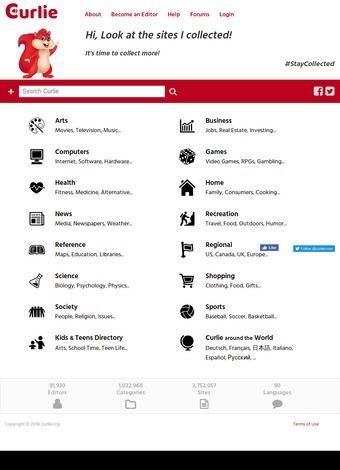
Curlie is an open-content web directory at curlie.org, built and maintained by a community of volunteer editors who sort sites into topic categories by hand. It is the direct continuation of the Open Directory Project, the long-running catalogue once known as DMOZ, relaunched under a new name and kept going on the same editorial model. The scale on paper is large: somewhere above a million topic categories, close to three million listed sites, and tens of thousands of editors working across more than ninety languages. Those numbers tell you what kind of resource it is, an attempt to map a substantial slice of the web through human judgement instead of a crawler.
What you do here is browse and search. The top of the tree splits into the familiar broad subjects: arts, business, computers, health, recreation, science, society, regional, and the rest. Each one drills down through layers of sub-categories until you reach a page of actual links, usually with a short editor-written description next to each. The search box cuts across the whole tree if you would rather jump straight to a term. There is also a path for submitting a site, where you point the relevant category editors at a page you think belongs in their section. None of this is flashy. It is plain, fast, and legible, and for a reference tool that plainness is closer to a strength than a flaw.
The part that gives Curlie its character is who does the cataloguing. Anyone can apply to become an editor for a topic area they know well, and once accepted they take responsibility for curating and pruning the listings under their patch. That is roughly ninety thousand people deciding, by hand, what gets in and how it is described. Curlie leans on this openly, summing it up with the tagline "#HumansDoItBetter," a small jab at the algorithmic indexing that swallowed the directory model years ago. Whether humans genuinely do it better is the interesting tension, and the honest answer is that it depends on the corner of the tree you land in.
Coverage, quality, and the limits of volunteer curation
Coverage is the obvious question, and it is uneven by nature. A topic with an active, attentive editor reads well: tight selection, current links, descriptions that actually tell you something. A topic whose editor drifted away years ago can feel frozen, with dead links and entries that predate whatever happened in that field since. This is the structural trade of any volunteer-run catalogue, and Curlie does not pretend otherwise. The flip side is that when a section is alive, the quality of curation beats almost anything a ranking algorithm hands you, because a person who knows the subject chose every line.
The multilingual reach is more substantial than I expected when I started clicking through it. Curlie carries trees for Northern, Southern, and Central or Southeast Europe, the Middle East, Africa, Asia, and Eastern Asia, each maintained by editors working in those languages. For someone researching a regional topic in its own tongue, that breadth is genuinely useful and is not something the big general search engines replicate well. It also keeps the project from being a purely English-language artefact, which the old DMOZ days tended toward.
Beyond browsing, Curlie runs a community forum where editors coordinate and discuss policy, and it accepts donations to keep the lights on, which fits an open project with no advertising model propping it up. Account creation and login exist mainly to support the editing side. These are not consumer features so much as the machinery that keeps a volunteer operation functioning, and seeing them out in the open is reassuring about how the thing is actually run.
The submission and editor model also means Curlie is participatory in a way most reference sites are not. If you find a gap, you can apply to fill it, and if you spot a stale section you can put your hand up to maintain it. That openness is the whole point, and it is also why the experience varies so much from one branch to the next. Treat the directory as a collection of independently tended gardens, some immaculate, some overgrown, all assembled under one structure. A section on vintage radio repair might be meticulous; one on a fast-moving software framework might be two years out of date. Neither outcome reflects badly on the concept, only on the distribution of volunteers.
Where Curlie still pulls its weight
It is worth being clear about what Curlie is for now, because its role has narrowed since the directory era. Few people use a catalogue like this as a daily front door to the web anymore. Where it still pays off is in deliberate discovery: finding the curated set of sites on a niche subject, sources that a person vetted and grouped, when a search engine would bury them under commercial pages. Researchers, students, and anyone tired of sponsored results will get more out of Curlie than someone looking for a quick answer. The historical weight matters too, since it is one of the last working pieces of the original open web directory and it carries that lineage intact.
Set against Wikipedia's external-links sections, which is where many people now go for a vetted starting list on a topic, Curlie holds a different and narrower advantage. Wikipedia gives you a few curated links inside an article; Curlie gives you a whole branch of them, organized and described, with no article to wade through first. A search engine hands you ten ranked results; the directory hands you a structured map of a field with editorial notes attached. If you want depth of links on a single subject and you are willing to accept that some branches are better tended than others, Curlie is the more focused tool. For a one-off fact-check, the encyclopedia wins outright. For building a reading list on an unfamiliar subject or for finding sources outside the first page of Google, the case for it is still coherent, even if the audience for it is smaller than it once was.
Outside reputation is limited: no significant volume of third-party reviews turns up in a public search. Curlie is the kind of reference tool that people use quietly rather than rate publicly, so the absence of review counts is not surprising and says nothing damaging about the site itself. The project has been running, in one form or another, since 1998, and the continuity is its own record. The site indexes roughly three million sites across more than ninety languages and has done so without advertising, which is a harder thing to maintain than it sounds. Whether a particular branch of the tree is worth your time is a question you answer in about thirty seconds of browsing, not by weighing external scores.