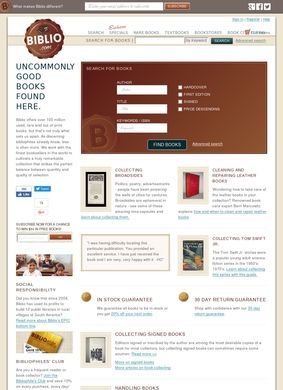
Where do you go when the book you want went out of print decades ago, or only ever existed as a signed first edition? Biblio is one answer. It is an online marketplace built specifically for used, rare, and out-of-print titles, pulling inventory from roughly 5,500 independent booksellers around the world into a single searchable catalogue that the company puts at more than 100 million books. That scale is the point for the kind of shopper who has already struck out at the usual retailers and needs a wider net.
The search itself is the part that decides whether a site like this is useful or just large. You can look by author, title, keyword, or ISBN, and then narrow by format, edition, and condition, so a request for a first-edition hardcover that happens to be signed is a few clicks and not a guessing game. The category breakdown is broad in a way that feels genuinely stocked rather than padded: general fiction, science fiction, fantasy, mystery, romance, children's books, textbooks, history, cookery, sports, hobbies, and religion all have their own corners. A buyer hunting a specific old cookbook and a student chasing a cheaper textbook are served by the same machinery, which says something about the catalogue's actual depth.
Where Biblio pulls ahead of a general resale site is how seriously it treats the collecting end of the market. There is a dedicated rare books section covering first editions, signed copies, antiquarian volumes, ephemera, manuscripts, and assorted collectibles. Alongside the listings, Biblio publishes editorial guides on book collecting, identifying first editions, and valuing books. That content is worth more than a marketing line, because the difference between a true first edition and a later printing dressed up as one is exactly where inexperienced buyers lose money, and a marketplace that bothers to teach that is one expecting repeat customers to know what they are doing.
Beyond the core buying experience, the company has layered on a handful of extras. A Bibliophiles Club membership program targets the regulars, gift certificates exist for the people who can never figure out what to buy a reader, and free shipping promotions show up periodically. There is also Biblio for Libraries, a procurement service aimed at institutions that need to source titles in volume. International orders are handled with integrated DHL duty calculation, a small detail that spares overseas shoppers the unpleasant surprise of a customs bill they did not budget for. Curated reading lists round things out for browsers who arrive without a specific title in mind.
The seller side is worth understanding too, because it explains where all those books come from. Independent bookshops list their stock through a subscription model, with fees starting around $5 a month plus a commission of roughly 8 to 12 percent per sale. That structure keeps the barrier low enough for small shops while giving the platform a revenue stream tied to actual sales. It is a sensible arrangement, and it lines up with the company's self-description as the largest independent book marketplace going. A buyer on Biblio is effectively shopping thousands of individual stores at once, which is both the strength here and the thing that makes consistency harder to guarantee.
Third-party scores
The picture is genuinely mixed, and that is useful to know upfront. Trustpilot carries an enormous volume of feedback, north of 35,000 reviews on an active profile. ResellerRatings is glowing, with around 700 reviews averaging close to a perfect five out of five. Then the numbers sober up: Sitejabber sits at three stars across roughly a hundred reviews, and the WorthePenny aggregate lands at about 3.8 from just under 400. The Better Business Bureau is more reassuring, listing Biblio as accredited with an A+ rating out of its Asheville, North Carolina base.
Read together, this looks like exactly what a marketplace of thousands of independent sellers would produce: plenty of smooth transactions and a meaningful minority of buyers whose experience depended on whichever individual shop they happened to order from. The spread is honest information and not a warning sign, but it tells you to read the specific seller's standing before paying for an expensive purchase. A platform this size averaging between three and five stars across different panels is not alarming; it is simply a reminder that results will vary by seller.
On reaching a human, Biblio comes across as reachable without being eager to advertise it. A Help link sits in the site header, and a phone number along with a mailing address are documented through the BBB listing. The contact route is not front and centre on the homepage, which is a minor frustration if something goes wrong with an order, though nothing is hidden so much as understated. For a company that has operated since 2000, that quiet approach reads as established and deliberate.
For anyone after used, rare, or out-of-print books, Biblio is worth the search, eyes open. The catalogue runs deep, the filtering is precise, and the rare-books editorial content reflects genuine expertise. Two decades of trading and BBB accreditation add some weight to the brand. The one qualifier is baked into any aggregator of thousands of separate sellers: the experience is only as good as the bookshop the order comes from, so the uneven third-party scores deserve attention before handing over money on a high-value buy. Check the individual seller, and the breadth Biblio puts in front of you is hard to match elsewhere.