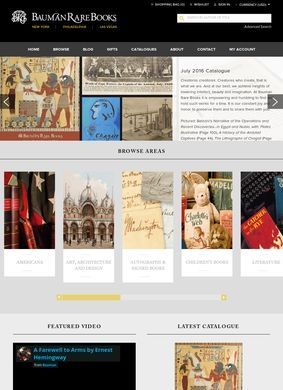
Suppose you want a true first printing of a Hemingway novel, or a Bible set in type in the 1600s, and you want to know it is what the seller says it is before money changes hands. That is the precise problem Bauman Rare Books exists to solve. The firm trades in first editions, signed and inscribed copies, and antiquarian volumes old enough to need careful handling, and the site is built around proving each one is genuine rather than simply listing it for sale. Items are documented by researchers on staff who record provenance and condition, which is the part that separates Bauman Rare Books from a shop that resells whatever turns up.
The inventory is deep and spread across collecting fields most buyers will recognise: Americana, literature, art, history, children's books, music, science, and photography. You can search by category or run an advanced query, and the range of what surfaces is wide. Shakespeare folios sit alongside seventeenth-century Bibles and first printings of major twentieth-century literary works. Prices reflect that. A single volume can run from a few hundred dollars into the thousands, and there is no pretense that this is casual shopping. Anyone browsing will quickly see the gap between an affordable signed modern first and a museum-grade rarity, and Bauman Rare Books does not hide where things land on that scale.
Beyond the catalogue, there is more here than a sales front. Bauman Rare Books keeps an electronic catalogue with a newsletter signup, sells gift certificates, and runs a consignment and acquisition service for people who want to sell books instead of buy them. A dealer willing to buy is a dealer who has to know value from both sides of the transaction. A blog, a glossary of rare book terminology, and a set of FAQs round out the resources. The glossary in particular is a small tell of seriousness: terms like points, states, and issue confuse newcomers constantly, and a dealer who explains them is one who expects informed customers and benefits from having them.
Three galleries and what they mean for a buyer
Bauman Rare Books runs three physical galleries: one in New York City on Madison Avenue, one in Philadelphia, and one in Las Vegas inside The Venetian. Having a room you can walk into changes the calculation for a buyer spending serious money. A rare book is a physical object whose condition you may want to see in person, hold, and compare against the written description before a payment goes through. The Las Vegas gallery, sitting inside a major resort, also turns Bauman Rare Books into something of a destination rather than a purely transactional stop, and the staffing of all three locations with researchers reinforces the documentation-first approach the site advertises.
Getting in touch with Bauman Rare Books is straightforward, which is not a given in this trade. A toll-free number is posted, along with addresses for all three galleries, a contact form, and even a fax option for anyone who still works that way. None of it is buried. For a category where buyers often want to talk through a specific copy, the visibility of a direct phone line makes a real difference.
Outside opinion is harder to read cleanly. On Yelp, the New York location has around eleven reviews and the Las Vegas location around sixty-three, and both appear on TripAdvisor, the Las Vegas gallery frequently turning up as a tourist stop. Sentiment across these platforms leans positive, with reviewers returning again and again to the breadth of inventory and, less flatteringly, to how expensive the books are. No aggregate star score came back from a search of the firm's name, so the picture is built from comments more than a single number, but the recurring praise for collection depth lines up with what Bauman Rare Books itself emphasises.
That breadth, though, is where a buyer should slow down. Bauman Rare Books sells objects whose entire value rests on authenticity and condition, and those are things a website can describe but not fully prove. The dealer's own researchers document provenance, which is reassuring as far as it goes, yet that documentation comes from the seller, not an independent party. For a Shakespeare folio or a seventeenth-century Bible, the difference between an honest grading and an optimistic one can be thousands of dollars, and nothing on the public-facing site lets an outside buyer verify a given copy without engaging directly. The positive reviews suggest customers have generally come away satisfied, but they describe the experience of browsing and the appeal of the rooms more than they confirm the accuracy of any particular high-value attribution.
So the verdict bends with the price tag. For modestly priced signed firsts, the established galleries, the documentation approach, and the consistently warm reviews make Bauman Rare Books an easy recommendation. At the top of the range, where a single mistake costs as much as a car, the open question is whether a buyer should rely on the dealer's provenance notes alone or bring in independent expertise before a purchase is finalised. The site, polished and thorough as it is, cannot answer that for you.