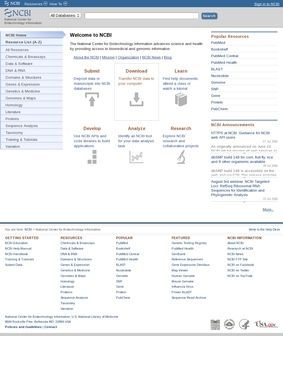
Here is the odd part: most people have used this place and could not name it. The National Center for Biotechnology Information is a division of the U.S. National Library of Medicine, sitting inside the National Institutes of Health, and it quietly hosts a large share of the world's biomedical and genomic data. Free. No login for the bulk of it. If you have ever chased down a scientific paper online, you have probably landed on its servers without clocking who ran them. The verdict is easy and unusual to write: this is foundational infrastructure, and the listing under Books undersells it badly.
Take the reading layer first, since that is where the Books category has its footing. PubMed is the index of peer-reviewed biomedical citations and abstracts. PubMed Central runs alongside it with full-text open-access articles. Then there is Bookshelf, a library of full-text books and reports across biomedicine and health, with clinical references, textbooks, and government health reports readable end to end in a browser. That last one is the real justification for the category. A whole book you can read start to finish, not a teaser and a paywall.
The sequence and genomics layer
Below the reading material is the part researchers touch daily. BLAST runs sequence similarity searches. Nucleotide stores DNA and RNA records, Protein covers protein sequence and structure, and Gene ties gene-specific records together across species. Whole-genome work leans on Genome for assemblies and annotations. The Sequence Read Archive holds raw high-throughput sequencing output. GEO Datasets is the functional genomics repository, there is a 3D Structure database for macromolecular models, and a Taxonomy database keeps organism naming consistent across the lot. None of this is decorative. For most of these data types, this is simply the primary global repository, full stop.
Clinical and variant resources
Different crowd, same address. ClinVar records human variants and their clinical significance. OMIM catalogs genetic disorders, MedGen organizes medical genetics information, dbSNP tracks single nucleotide polymorphisms. For study-level data, dbGaP links genotype and phenotype information from research cohorts. PubChem handles the chemistry side with compound, substance, and bioassay records, which is where pharmacology and genomics start to overlap.
So several distinct groups share one front door. A clinician checking whether a variant is dangerous, a graduate student pulling abstracts at midnight, a bioinformatician scripting against an API, a curious person reading a health report, all arrive at the National Center for Biotechnology Information and wander into different corners. Holding it together underneath is MeSH, the controlled vocabulary of Medical Subject Headings, which standardizes how topics get tagged across the literature. BioProject and BioSample do the equivalent organizing for datasets and the physical samples behind them.
How the collections stay current
Two things keep this from going stale. Submission portals let researchers deposit their own sequences and study data, so the collections grow from the community that uses them. And the data flows back out programmatically: APIs and code libraries let developers build applications on top of the holdings, while bulk download services serve anyone who needs whole datasets instead of single-record lookups. Those access modes are what turn a pile of databases into working infrastructure for the field.
For newcomers, the educational materials are worth flagging. Knowing BLAST exists is one thing. Framing a query and reading the output correctly is another, and a quietly hard one. The National Center for Biotechnology Information publishes tutorials and guidance aimed squarely at that gap, which is not easy to do well at this scale of complexity.
On cost: almost everything here is free, and most of it needs no account. In a field where primary literature and specialized datasets routinely hide behind subscriptions, that changes who can do the work at all. PubMed Central gives you full text rather than an abstract alone. Bookshelf gives whole books. The practical effect is that the National Center for Biotechnology Information often lets you finish a research trail without slamming into a paywall halfway through.
What sets it apart is breadth that someone actually wired together. Twenty-plus databases could have ended up as twenty-plus silos. Instead the cross-linking, shared vocabularies, and consistent search behavior mean a record in one resource usually points to related records in others. Start at a gene and you can reach the papers, the variants, the structures, and the surrounding chemistry without leaving the site. A single ClinVar entry can hop to the underlying study in dbGaP, the variant in dbSNP, and the disorder in OMIM. The genomic and clinical depth puts the National Center for Biotechnology Information well past a plain literature index, and the literature index alone is among the most consulted in science.
If you are weighing whether to bother: skip the front page and go straight to the tool you need. Bookmark PubMed for citations, Bookshelf for full reading, BLAST or Gene if you are doing sequence work. The published holdings tell you everything you need to judge this one. There is nothing to second-guess here, and the National Center for Biotechnology Information has earned that.