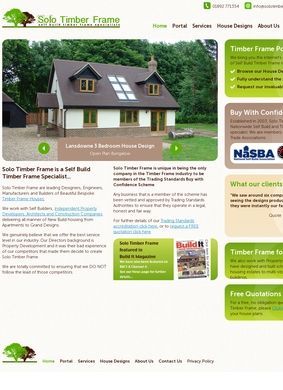
Picture someone who has bought a plot, sketched a rough idea of the house they want, and now faces the gap between a drawing and a building that will stand up. That is the moment Solo Timber Frame is built for. The company designs, engineers, manufactures, and erects timber frame homes across the UK, which means a self-builder can hand over a vague vision and get back a structural kit that arrives ready to assemble. The work covers the bones of a house: external walls, internal partitions, floor joists, roof trusses, and the assembly plans that tell a crew exactly how the pieces fit together.
The offer is split into clear stages, so a client can take as much or as little as needed. The structural supply is the core product. On top of that sits an optional package for windows and doors, both supplied and installed, for people who would rather not coordinate a separate trade. Then there is a design tier that handles architectural and building control drawings, foundation design, and project management support. A developer who already has a design team can take the frame alone, while a first-time self-builder with nothing but an empty field can lean on the full service.
Design and structural supply
The way the house catalogue is organised tells you something about who Solo Timber Frame expects to walk through the door. Designs are sorted by bedroom count, running from one bed up through five and beyond, with bungalows kept as their own group and a fully bespoke route for anyone whose plot or taste does not fit a standard plan. That structure makes browsing genuinely useful: a couple looking for a modest two-bed retirement bungalow and a family chasing a five-bed home are not forced to wade through the same long list.
There is also a separate track for barn and Part Q conversions, which is a smart inclusion. Permitted development conversions carry their own planning quirks, and pulling them out into a dedicated stream shows the team has done this kind of work before and knows it is not the same job as a new build on open ground. Foundation design sitting alongside the frame is worth noting too, because the frame and the slab beneath it have to be engineered as one system, and a supplier who handles both removes a common point of friction.
For people weighing whether to attempt a self build at all, the site carries a self-build blog and a free advice section, plus more than a dozen listed service categories. A free advice section is a reasonable proxy for how much a company wants its customers to understand the process before they sign anything, and here it reads as genuine groundwork for nervous first-timers. The bespoke design service is the part that will appeal to anyone with an unusual plot, since a frame engineered to order can follow a footprint that an off-the-shelf plan never could.
Credentials and standing
Solo Timber Frame is a registered company with a VAT number on display, which is the baseline you want from anyone you are about to trust with the shell of a house. Beyond that, it holds Which? Trusted Trader status and is an approved member of the Trading Standards Buy with Confidence scheme, with a verified profile on the government-backed buywithconfidence.gov.uk site. Those two accreditations are not handed out casually; both involve vetting, and for a build that runs into six figures, that kind of formal scrutiny is genuinely reassuring.
The third-party review picture is sparser than the accreditations, and it is worth being straight about that. On Trustpilot, Solo Timber Frame shows four reviews at a four-star average, which is a small sample by any measure. Its own site cites a Google rating of 4.6 out of 5, though the number of ratings behind that figure was not visible. There is a Houzz profile and a Rated People profile as well, but the review counts on both were not on show in what I could find. The sentiment that exists leans positive, yet there is not a deep well of public feedback to draw a firm conclusion from. For a structural supplier serving builders and developers, that is not unusual, since much of that trade comes through word of mouth and repeat clients who never leave an online review, but a prospective customer should treat the ratings as encouraging, not as a settled verdict.
A landline number, an email address, and a physical address in the BR3 postcode are all stated plainly on the site. For a business that will be sending lorries of timber to your plot and crews to put it up, a real street address you can look up is reassuring in a way that a contact form alone never is. That openness sits comfortably with the accreditations.
Scope and fit
The named audience is broad: self-builders, independent property developers, architects, and construction companies. That spread makes sense for a manufacturer that can supply anything from a single bespoke frame to a repeatable bungalow design, pointing to a business comfortable working with both one-off clients and trade buyers who place orders regularly. An architect can hand over drawings and get a frame engineered to match; a developer can order proven designs at volume; a homeowner can be walked from foundation to roof.
The clearest limit is geographic and product-shaped rather than a flaw. Solo Timber Frame works in timber frame only, so anyone set on masonry or a steel-framed structure is in the wrong place. Solo Timber Frame does not pretend otherwise, and that honesty about scope is part of what makes the offer coherent. And while the company works across the UK, the single Kent-area base is worth factoring into delivery and erection logistics if your plot sits at the far end of the country. None of that undercuts the offer; it just defines its edges.
Set Solo Timber Frame against a national operator such as Potton, the long-established self-build timber frame brand with its own show centre, and the trade-off comes into focus. Potton brings scale, a physical place to walk through finished homes, and decades of marketing reach. Solo Timber Frame answers with a more flexible, supply-what-you-need structure, two independently vetted accreditations, and genuine bespoke engineering that suits a buyer who wants a frame shaped to an awkward plot rather than a polished showroom experience. The published credentials of Solo Timber Frame are solid; the one gap is a shallow pool of independent reviews, which a few project references from recent clients would fill. Get those early in any conversation and there is a credible case for taking Solo Timber Frame seriously.