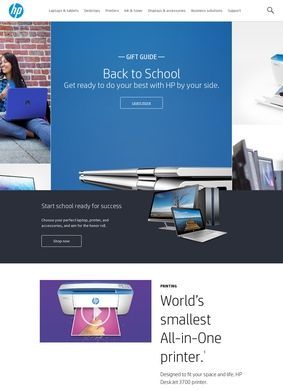
A laptop refuses to print, the cartridge is empty, and the driver vanished after a Windows update. That is the ordinary mess that sends people to hp.com, and the site is built around exactly those moments. There is a search by product, a place to type a serial number to check warranty status, and downloads for software and drivers sorted by model. Troubleshooting paths are tied to specific products, so a printer problem and a workstation problem do not dump you into the same generic help article. Hewlett-Packard has clearly spent real effort on the self-service layer, and it shows.
Hewlett-Packard sells a wide spread of hardware here, and the catalogue rewards a slow scroll. Laptops break out into consumer, business, gaming, and AI PC lines, including the Copilot+ machines, the OmniBook range, the EliteBook X Series, and mobile workstations for people who need real horsepower on the move. Desktops follow the same logic, from home and gaming towers to the OmniDesk and the Z Workstations aimed at engineering and creative work. Printers cover the full range too: home and office inkjet and laser units, the Smart Tank models, and large-format printers and plotters for the people who genuinely need a plotter. Monitors, scanners, accessories, and the consumables (ink, toner, paper) round it out.
Two branded peripheral families sit alongside the core gear. HyperX handles gaming peripherals, and Poly covers video and voice collaboration hardware, the kind of kit that ends up in meeting rooms and on the desks of people who spend their day on calls. Keeping those under the same roof means someone outfitting a small office can pick a desktop, a monitor, a headset, and a conference camera without leaving the site.
The subscription and support side
Where the catalogue gets genuinely interesting is the shift toward services you pay for monthly. HP Instant Ink ships cartridges before you run dry, starting at $7.99 a month, and it is the entry point to a wider idea: stop buying a printer outright and rent the whole arrangement. The HP All-In Plan bundles a printer, ink, and support for the home, and there is a business version of the same. For people who would rather not think about toner levels ever again, this is a real answer, and it tells you where Hewlett-Packard expects its revenue to come from over the next decade.
Support has its own paid tiers. SmartFriend is a tech support subscription for the moments when something breaks and you want a human, and Care Packs extend warranties and add support contracts on top of what a product ships with. None of this is hidden behind a sales call; the plans are laid out on the site with their terms, which is more transparency than some competitors manage. For a company of this scale, keeping that information accessible rather than burying it in quote requests is worth noting.
For larger buyers, the offering changes shape entirely. The HP Workforce Experience Platform is a digital employee experience management tool, and Hewlett-Packard points to its placement in the Gartner Magic Quadrant for DEEM tools as evidence it holds its ground against rivals. The scale claims are concrete: AI-driven device monitoring across 48 million endpoints. That is the sort of number that means something to an IT director managing a fleet, and it is backed by procurement programs aimed specifically at government agencies and educational institutions, with the Z Workstations slotting in at the high end. Hewlett-Packard is playing in a different league on this side of the site, and the enterprise pages make that plain.
The site does not pretend everyone shopping is the same person. A student buying a first laptop, a freelancer choosing a monitor, a small business owner weighing an All-In Plan, and an enterprise architect speccing out endpoint management all get distinct routes through hp.com, and the navigation mostly keeps them from tripping over each other. A parts store and standalone driver downloads serve the people who already own the hardware and just need to keep it running, which is a quieter but constant kind of customer. Compared to a generic business directory entry pointing somewhere, this is a full operation.
A few promotions thread through the experience, like the HP and Adobe free trial, which is the usual cross-sell but a reasonable one given who buys creative workstations. There is also clear separation between what you can configure and buy on the spot and what needs a heavier procurement conversation. A consumer can check out a printer in minutes; a school district buying a hundred of them lands in the education program path instead.
What holds the whole thing together is range with depth behind it. Hewlett-Packard could have settled for a bare storefront pointing at retail partners, but the warranty checker, the model-specific driver library, the troubleshooting tied to individual products, and the parts store all point toward a site meant to carry a product through its entire life, past the moment of sale. The Instant Ink and All-In plans push that further, turning a one-time purchase into an ongoing relationship, for better or worse depending on how you feel about subscriptions creeping into hardware.
The enterprise material is where Hewlett-Packard makes its strongest case for being more than a box mover. Managing 48 million endpoints with AI monitoring, a DEEM platform that survives analyst scrutiny, dedicated lanes for government and education procurement: this is infrastructure-grade work sitting on the same domain as a $7.99 ink plan. The breadth is unusual, and the site does a decent job of letting each audience ignore the parts that are not for them. Hewlett-Packard does not force the enterprise buyer through the same pages as someone looking for a replacement ink cartridge.
Consumer and enterprise sit oddly close together on hp.com, and the site mostly avoids flattening one into the other. A gaming laptop page reads nothing like the Workforce Experience Platform page, and that is appropriate, because the people landing on each want completely different things. The OmniBook and EliteBook X naming, the Z Workstation tier, the Poly and HyperX sub-brands, all of it points to a company that segments hard and trusts buyers to find their lane. Hewlett-Packard has resisted the temptation to sand down those distinctions for the sake of a tidier homepage.
The printer and ink ecosystem will be the deciding factor for a lot of visitors. Hewlett-Packard has tied hardware, consumables, and support into plans that range from a few dollars a month to full business bundles, and the Smart Tank line offers an alternative for anyone who would rather buy ink in bulk and skip the subscription entirely. Both options live on the same pages, so the choice is at least presented honestly. The driver and software downloads sit a click away, which keeps an aging printer usable long after the box is gone.
Leave hp.com and the lasting impression is volume handled with some discipline. The product tree runs from a single replacement cartridge to a 48-million-endpoint management platform, and Hewlett-Packard has built enough structure around it that a buyer can move through without the site collapsing the distance between those two extremes.