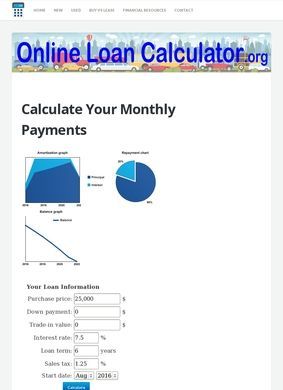
How much will that car cost per month before the dealer's finance desk gets a vote? That is the question Online Loan Calculator was built to answer, and it answers it with more granularity than the quick estimators bundled into most car-shopping pages. You punch in the purchase price, your down payment, any rebates, the value of a trade-in, the interest rate, the loan term, and your local sales tax, and it returns a monthly figure plus the math behind it. There is even a field for the loan start date, which sounds fussy until you realize it lets the amortization line up with a real calendar.
That amortization output is where Online Loan Calculator stops being a toy. Most free calculators hand you a single number and call it done. Here you get a full schedule you can read month by month or roll up into yearly totals, so the slow erosion of principal against interest is visible instead of theoretical. The site also lays a bi-weekly payment option next to the standard monthly one, which is the kind of comparison that quietly saves people money over a long term, and it draws charts for anyone who reads a curve faster than a column of figures.
The audience splits into two groups, and Online Loan Calculator clearly knows it. One is the ordinary buyer trying to sanity-check a salesperson's payment quote. The other is the automotive or dealership webmaster, because the site offers an embeddable widget: copy a snippet, drop it on your own car site, and the calculator runs there. I find that second use case the more interesting of the two, since it explains why the underlying math has to be genuinely solid, since other people are staking their own pages on it. A tool that other people syndicate onto their own pages cannot afford to be sloppy about tax handling or trade-in offsets.
Beyond the payment field
The calculator is the headline, but it is not the whole site. There are written sections on buying a new car and buying a used one, the sort of guidance that pairs naturally with someone who has just discovered what their monthly number actually is. A separate buy-versus-lease comparison tool sits alongside the loan math on Online Loan Calculator, and that pairing makes sense: the people who want to know their payment are frequently the same people still deciding whether to finance at all. Putting the two questions in one place is a small structural choice that reflects how car shopping really happens.
There is also a financial resources section that wanders a bit wider, into scholarships, loans, and grants. This is the part that feels least tied to the core purpose. It is useful in a general way, but a person who arrived to figure out an auto payment may not have come looking for scholarship information, and the connection between the two is loose. It does not hurt anything, and some visitors will appreciate the extra reading, yet it reads more like an attempt to broaden the site's reach than a natural extension of the calculator itself.
Online Loan Calculator describes itself as the leading online calculator for new and used car loans. That is a self-applied label, and it is worth treating as marketing rather than measurement. What can be said fairly is that the depth of the calculator backs up the ambition behind the claim better than a thinner tool would. The inputs are comprehensive, the outputs go past the single number, and the widget program suggests the operators have put real work into making something other sites would want to reuse.
On the matter of who stands behind Online Loan Calculator, the picture is mixed. There is an About Us page, and it carries a contact form asking for name, email, phone, and comments, plus a direct email address for reaching the team. That is a reasonable contact route, and the form covers most of what a visitor would need to get in touch. What is missing is anything more grounding: no physical address appears anywhere on the site, and no phone number is published for people who would rather call than type. For a free online tool that is not unusual, and I would not weigh it heavily, but it does mean the operation stays somewhat faceless. You learn what the calculator does long before you learn who built it.
The contact details also sit a click away from where most people land. Nothing about getting in touch surfaces on the homepage; a visitor has to navigate to About Us to find either the form or the email. That is a minor friction, and anyone determined to make contact will find the page, yet it reinforces the sense that the site is built around the tool first and the relationship with the user second. For a calculator that may be the correct priority. People mostly want the answer, not a conversation.
Outside opinion is the thinnest part of the story. A search for what other people say about Online Loan Calculator turns up its own pages and a crowd of competing calculators, the well-known names like Bankrate and calculator.net among them, but no third-party ratings on the usual platforms. No Google reviews, no Trustpilot score, nothing from the BBB or Yelp surfaced. That absence is not damning for a utility of this kind, since few people think to rate a calculator the way they would rate a restaurant, but it does mean the tool has to earn trust on its own merits. There is no chorus of users vouching for it, so a first-time visitor is judging it purely on how the math behaves.
That puts the weight back on the product, which is where it probably belongs. The strongest argument for Online Loan Calculator is the granularity of its inputs and the honesty of its outputs. A calculator that accounts for rebates, trade-in value, and local sales tax in the same pass will get closer to a real-world payment than one that pretends those things do not exist, and the amortization table means you can check its work instead of taking the headline figure on faith. For a buyer walking into a dealership wanting a number to argue from, that is genuinely useful preparation.
Where Online Loan Calculator is weaker is everything around the calculator itself. The written guides are fine without being authoritative, the resources section drifts off topic, and the lack of any public identity or third-party validation leaves a faint question mark over who maintains it and how current the tax assumptions stay. None of these are reasons to avoid the tool. They are reasons to use it as a strong estimate rather than gospel, which is how any free calculator should be treated anyway.
Set against the broader field of car-payment tools, Online Loan Calculator holds up well on the one thing that matters most, the calculation, while staying ordinary on the things around it. The widget for webmasters is a real differentiator and hints that the operators see this as infrastructure other sites can build on, well beyond a single page. Anyone in the middle of car shopping could open Online Loan Calculator, model a few scenarios in minutes, and walk away with a clearer sense of what they can afford. The deeper question is one only you can settle: once the tool tells you the monthly number, are you prepared to hear that the car you want costs more than you thought?